One of the most misunderstood skills in Rugby is kicking, here we look at how England deploy kicking as an attacking weapon.
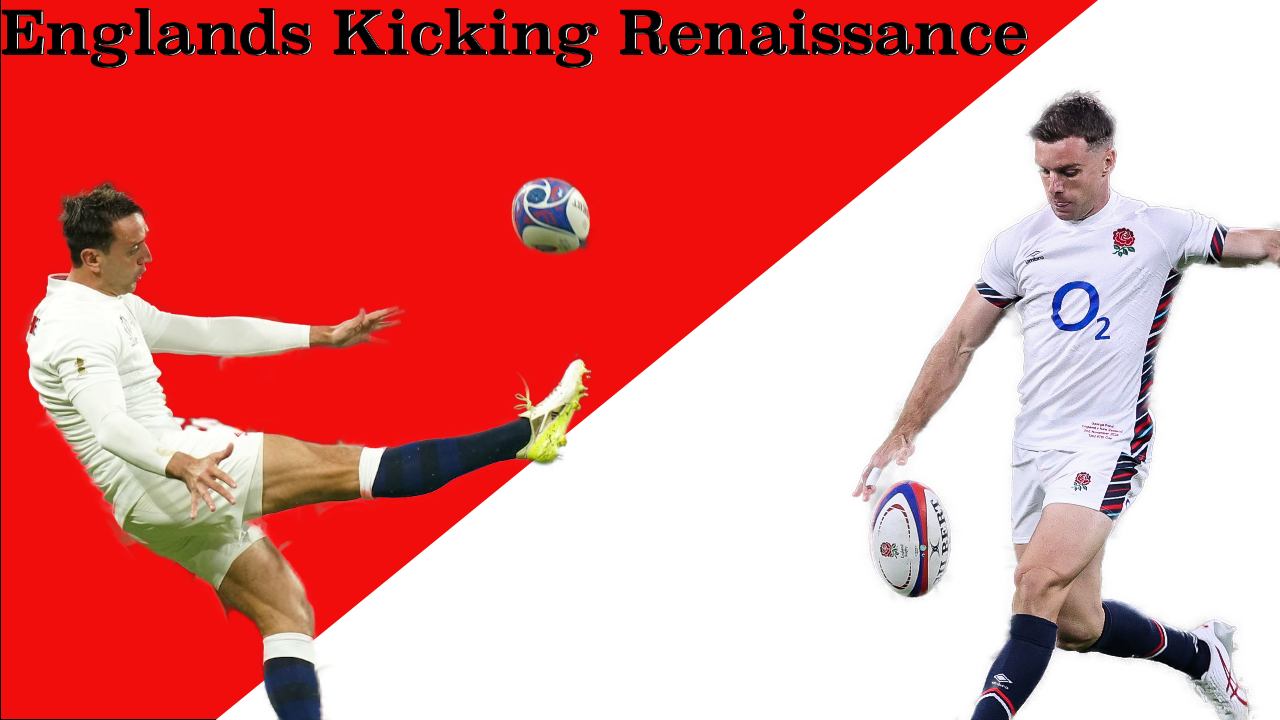
OOn the one hand stats will tell you kicking is a strength for the best teams in the world and on the other, it’s often seen as a defensive measure for teams that can only play one way.
The problem is that “the best teams kick more” statement is too often used as a reason to excuse poor kicking be it aimless or not, and the “kicking is born of negative mindset” is likewise rolled out for good teams as well as bad because many remain under the impression the only way to win games is by throwing the ball around.
While everyone is a fan of slick handling, I think the truth is somewhere in the middle. That good teams embrace kicking as another weapon in their armoury and utilise it alongside strong skills across the core of the game. The perception that kicking is somehow not in keeping with the sports core values comes from a misunderstanding of what is required to win, not just test matches but all forms of the game.
One of the most heavily criticised teams for kicking has always been England, mainly due to a narrative that all Rugby players and the game is the same the world over. Surely what one player can do, so can another; “well if New Zealand can fling the ball around why can’t England?”.
Unsurprisingly the truth is you actually have to play to your strengths and England have worked hard to make kicking a strength within their game. Does it mean you can’t develop, no, but both from a point of tactics and execution abandoning where you are strong is seldom more than self destructive.
Steve Borthwick understands the assignment and if we look at kicks from hand in the Autumn internationals we can see that, Australia aside, in each game one of the starting half backs kicked more than their Premiership season average.
Stretching further back to the Summer Tour where England, shorn of the Smith Twins built a game plan based on kicking that not only dismantled Argentina at home but built the blue print for the Autumn Internationals.
In tandem George Ford grabbed the chance to cement his status as Englands first choice number 10 and kicking again, was instrumental.
Numerically we can see that Ford kicked 22 times in test one vs Argentina, 17 times in test two and 15 times in the USA test, well above his Premiership average.
We can also understand Englands kick frequency and why, by looking at the starting halfbacks pass to kick ratio over the last 7 tests:
Correlating this ratio with what we understand about Englands tactical approach, demonstrates their game revolves around a modified “3 & kick” in their own half.
If you’re not familiar, that’s basically a teams approach to not creating space or momentum off early phases. if neither are presented in 3 rucks we’ll revert to a kick & pressure strategy.
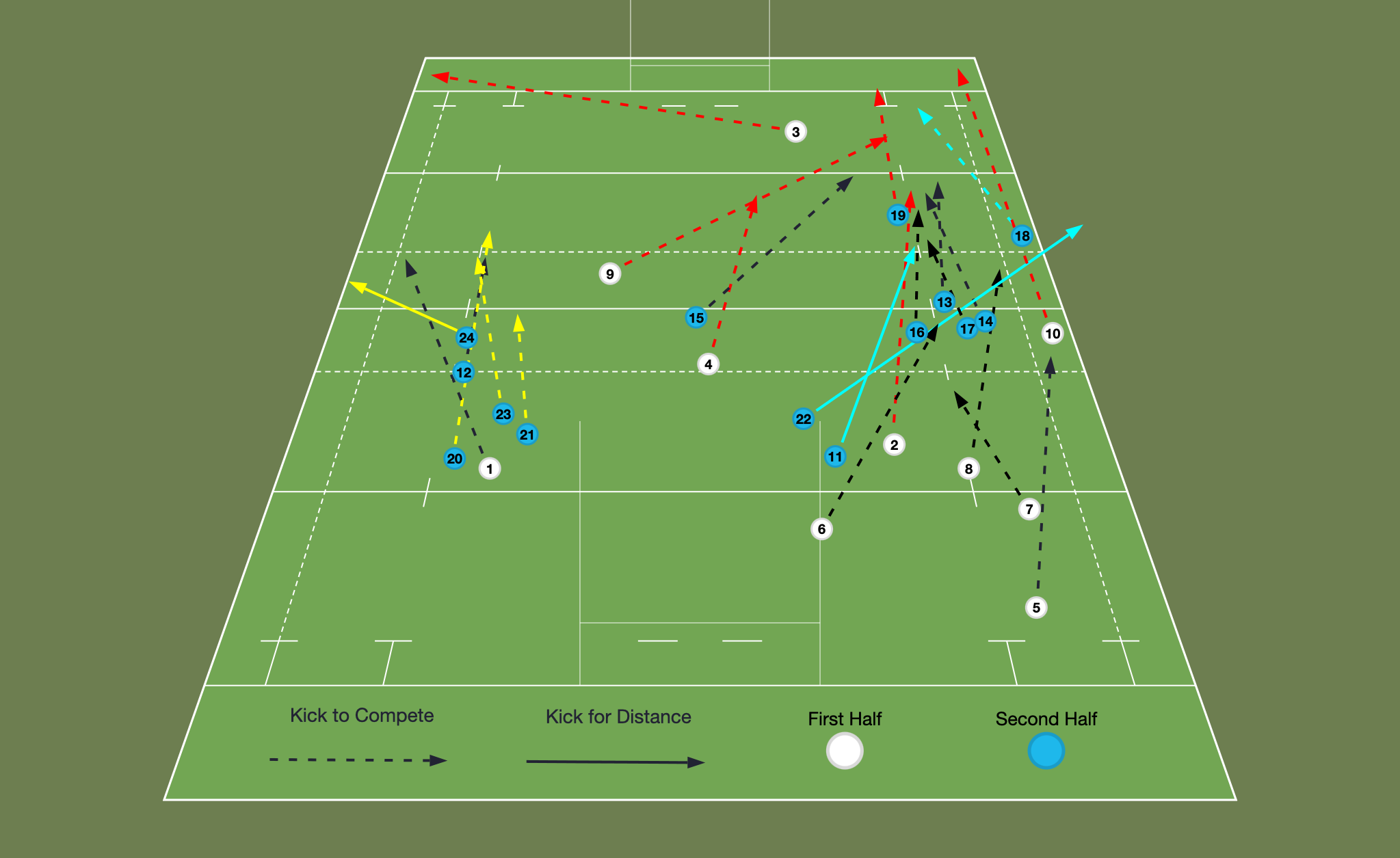
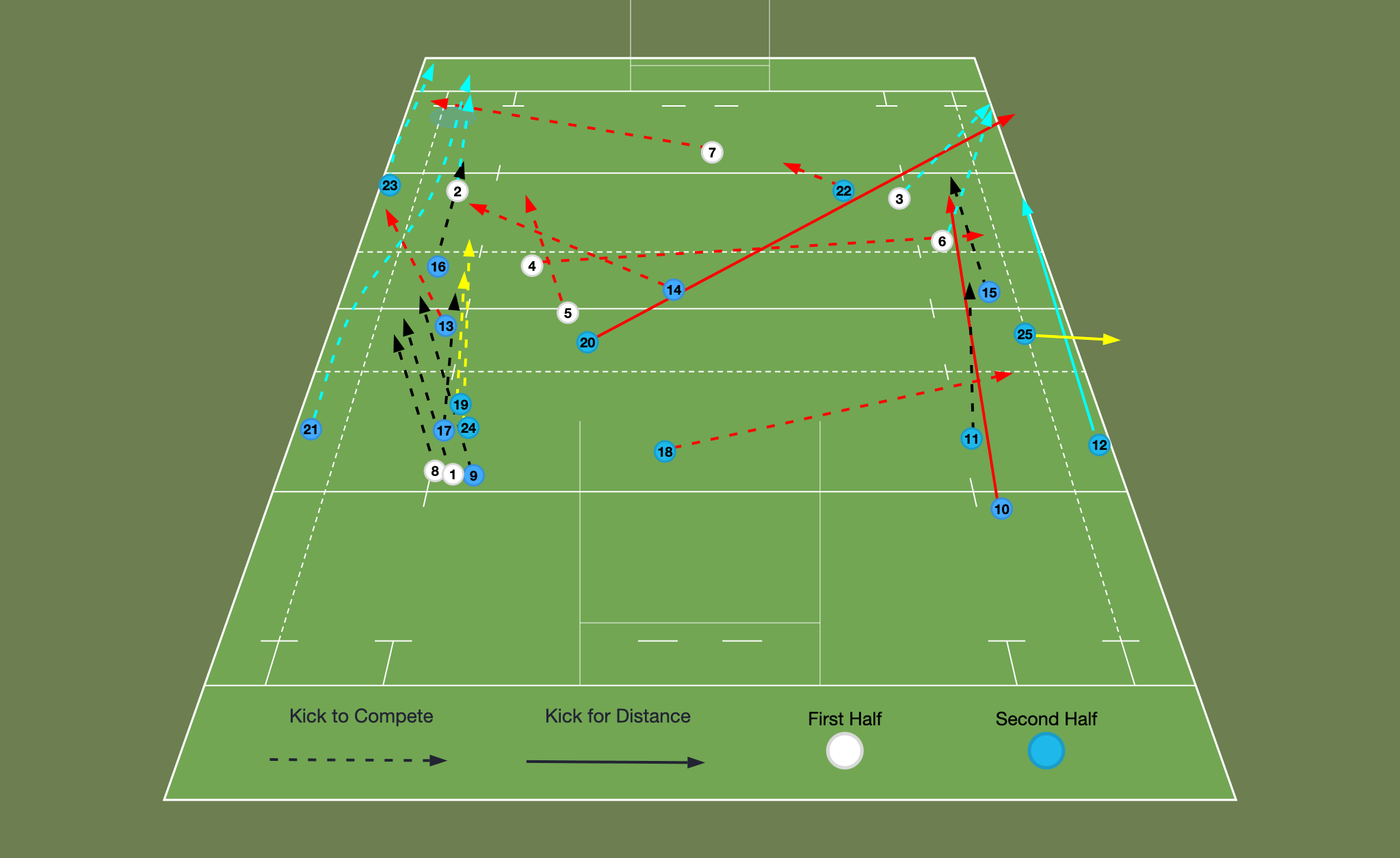
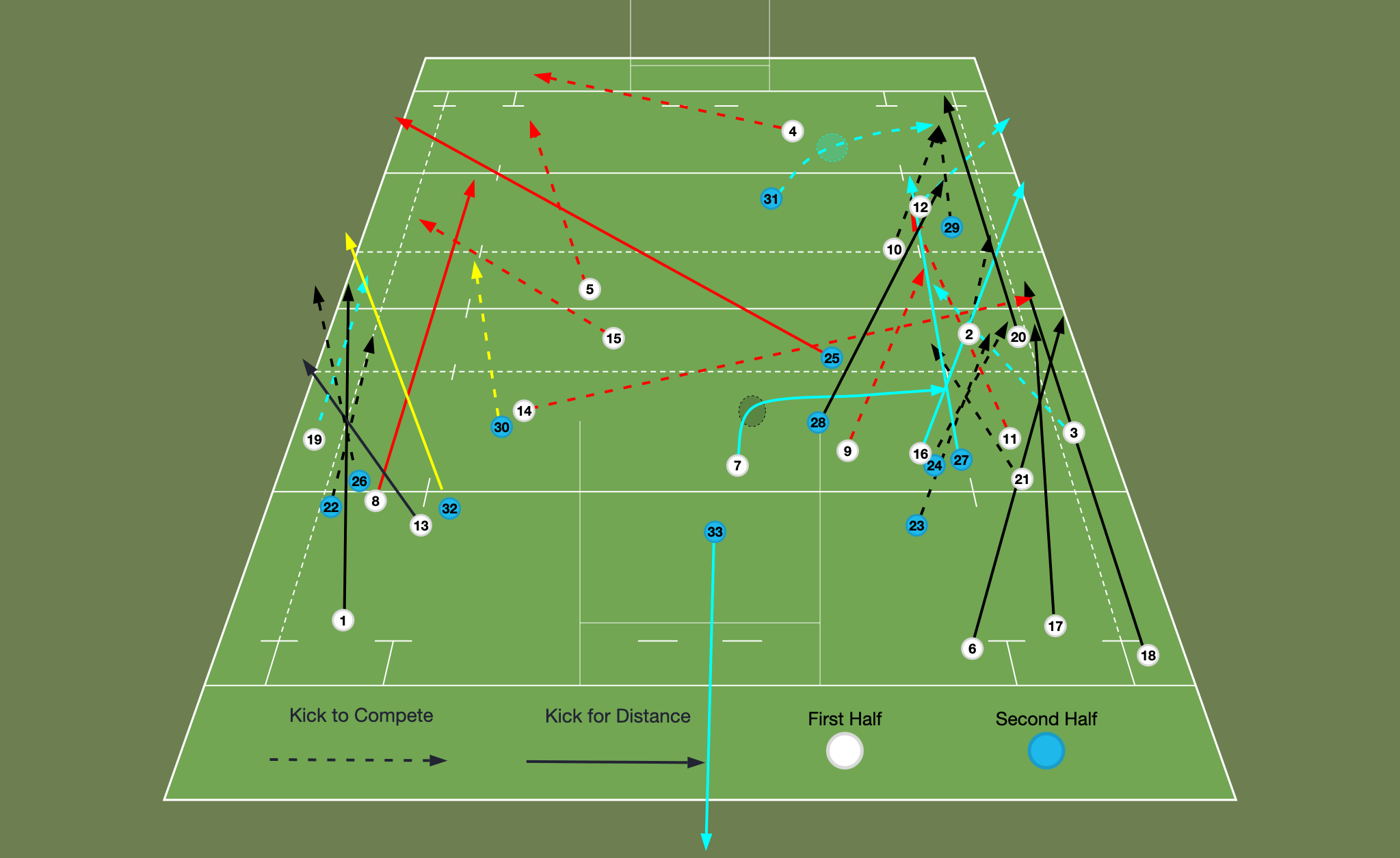
Let’s quickly look at Englands kick maps for the Autumn Internationals which illustrates where England utilise kicks. Note how many originate in Englands own half but also how many are kick to compete (dotted line).
Within these maps, Black lines are kicks by Alex Mitchell, red the starting fly half, yellow Ben Spencer and blue by all other kickers.
Game one vs Australia: Mitchell, Ford, Spencer
Game Two vs Fiji: Mitchell, F Smith, Spencer
Game Three vs New Zealand: Mitchell, Ford, Spencer
Game Four vs Argentina: Spencer, Ford, Mitchell
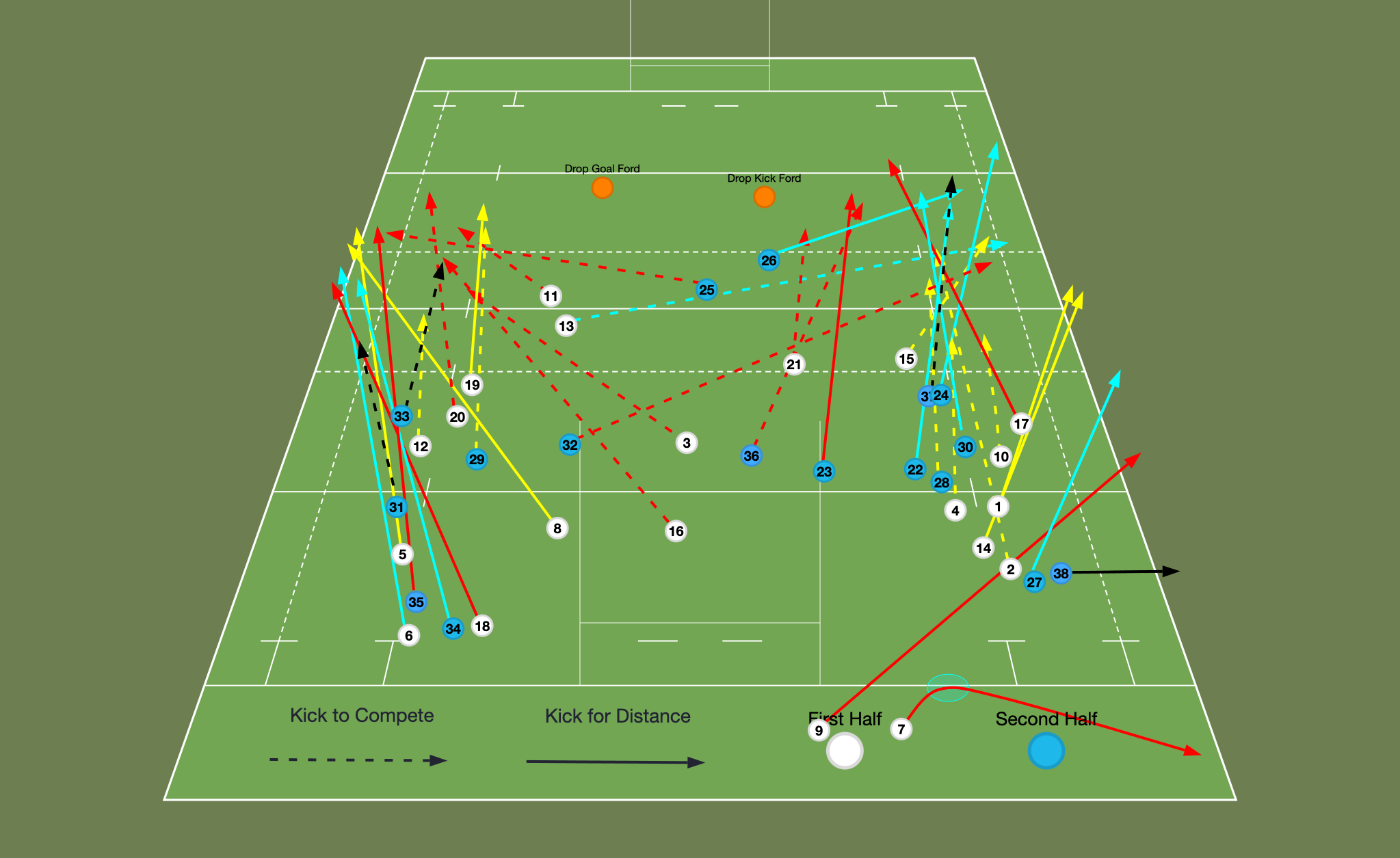
The point isn’t to count kicks but to illustrate that kicking is deeply engrained in this England team psyche and where they use it is key. Something that is important to understand though is the difference between not just tactical kicking but kicking as a strike weapon.
As teams have improved and the skills around kicking became far more rounded it is now used as not just a tactical tool to clear the half, or win territory but a means to generate high tempo attacking situations as well.
A perfect example of this is the resurgence of Englands attack focused kicking game and with the development of strong kicking Half Backs and a back three with exceptional aerial skills (after all a kick is only as good as it’s chase) they have quickly made it one of their key strengths to the point it has become an primary source of points.
During the Autumn Internationals England kicked tactically 116 times.
32 kicks were in their own 22, of which 22 were not kick to compete kicks (so defensive kicks for territory).
Further more of the 116 kicks during the AI’s 39 kicks were non-competitive kicks.
So on 77 occasions England kicked to either regain or force an error.
Across the four Autumn Internationals England played in 2025, they scored 17 tries.
Although a small window of games, if we look at the point of origin of each try we can see Kicking outstrips phase play by almost double and beats set piece (including Strike Moves) in terms of starting points for tries.
Very clearly tactical, two tries came from cross field kicks, with a third denied by the questionable actions of Australias Kellaway:
Now, yes, Ojomohs kick was more opportunistic than Ford and Smiths but , the point is that cross field kicks pass is a key weapon for England.
The others:
1: Vs Australia – Earl try, from a kick to Compete at 20 minutes (note immediately after a score conceded by opponents).
2: vs Australia – Pollock try, from a kick to Compete at 58 minutes
3: vs Fiji – Arrundell try, kick chase from turn over
4: vs NZ – Roebuck Try, 76 minutes fly hack ahead
Now granted those last two are extremely opportunistic and less about strategy but keep in mind there were other opportunities passed over, such as Dingwall’s knock on in goal vs Fiji from the grubber ahead by Smith.
With England looking quite settled with both first and second choice halfbacks (Mitchell, Spencer, Ford and Smith) and a settled back three of: Steward, Feyi-Waboso, Roebuck, Freeman and Smith we can expect to see these tactics continue across the Six Nations and into the Nations Championship.
England won’t be alone in utilising these skills, Ireland and France both sides that understands the importance of a good kick strategy (though it’s worth noting France don’t quite have the aerial skills of England and Ireland) as do the OG’s South Africa.
Teams will now be ready for this and it will likely be less of a smash and grab tactic, but with what’s looking like one of the most well rounded approaches to the game England look to have the weapons to move defences away from the areas they want to attack before striking.
Many thanks to the #Bajad8ta team for their help in putting this together.
Thanks for reading, more available on: https://substack.com/@thedeadballarea
Author: The Dead Ball Area
Graeme Forbes has run The Dead Ball Area since 2014. He has previously contributed analysis to Green and Gold Rugby and Rugby Dump as well as clubs in the Top 14 and URC.