Unlike the Men’s, the Women’s Sevens series is a much younger competition but since it’s full introduction during the 2012/13 season, the game and coaching has quickly professionalised leading to Women’s Svns unquestionably becoming an elite level sport.
Australia and New Zealand who highly value Svns in their development pathway have adapted better than most, allowing them to pull away at the top of the pile and it’s no surprise they’ve dominated, between them winning every series since it’s inauguration, New Zealand the dominant force winning 9 of the 12 series with Australia taking 3.
The last two SVNS series combined (23/24 & 24/25) there have been 15 finals. 11 have featured NZ of which they’ve only lost 2, both to Australia. If we include the the current season, then over the last 17 tournaments, 10 finals have been between NZ and Australia and all 17 have featured one of either NZ or Australia.
Since the Women’s code professionalised probably the biggest impetus for attacking change has been, much like 15’s, improved defence.
Defence being far simpler has matured at a tempo that has far outstripped the more complex skills of attack.
Where previously teams tended to run phases from edge to edge, taking teams to that width the width is no longer used to create space on the outside but spaces through the middle, that space in the middle has become even more important than space on the edge.
To generate that space Svns teams have had to develop an ability to break down defence with unstructured play in a way we’re only now seeing emerge in 15’s.
Key to this has been the benefits of staying on their feet even in contact and looking to create one on one situations, isolating defenders pre-ruck and exploiting their lack of support.
We can see below the in game stats.
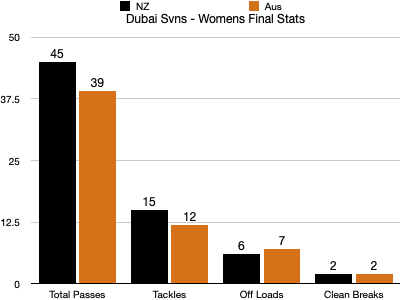
But what this doesn’t show us is tactical approach each team takes to playing this final.
We get a slightly better picture by breaking down into average passes per event:
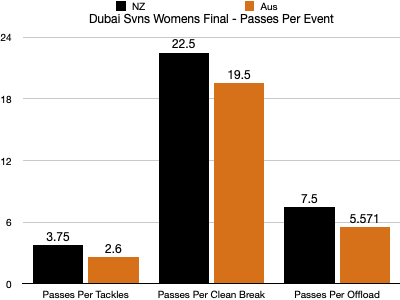
Though this gives a slightly better view around the approach of each team, it still lacks detail that we can pull out a little more by looking at the number passes made per phase of play (between Rucks).
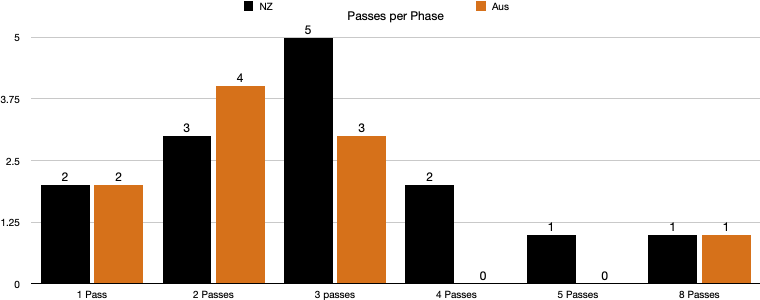
In a 14 minute game with reduced numbers this shows us a few things about New Zealand and putting all this together, the number of passes being high and opponents tackles low, we can see how New Zealand kept the ball alive restricting Australia to an average of 2.4 tackles for every try scored.
Australia in contrast needed to suffer 15 tackles for a score singles score.
Much like with 15’s scoring on either low or high phases is key – getting into the middle ground is likely to lead to turn overs which in turn is a perfect attacking moment exposing your unset defence.
Those sequences of passes resulted in 6 tries, with New Zealand scoring 5 and Australia 1.
NZ scored two tries from gathering loose ball, but also scored twice within making 2 passes from the ruck, Their opening try was scored after an 8 pass phase.
However their two 2 pass scores came after turning over a 6 pass sequence by Australia and then converting a 12 pass multiphase sequence.
I agree these are just numbers but what they illustrate to me is the need for ball movement and how fatiguing that is (in both defence and attack).
Where Australia tended to go edge to edge a little more that ball movement is key for New Zealand, and no where more clearly is this demonstrated than by their opening Try, scored by Stacey Waaka.
We’ll use a combination of Tactical Boards and Video to track their approach play.
New Zealand Turn over the ball from a loose Australian pass and immediately move the ball to the edge with three passes.
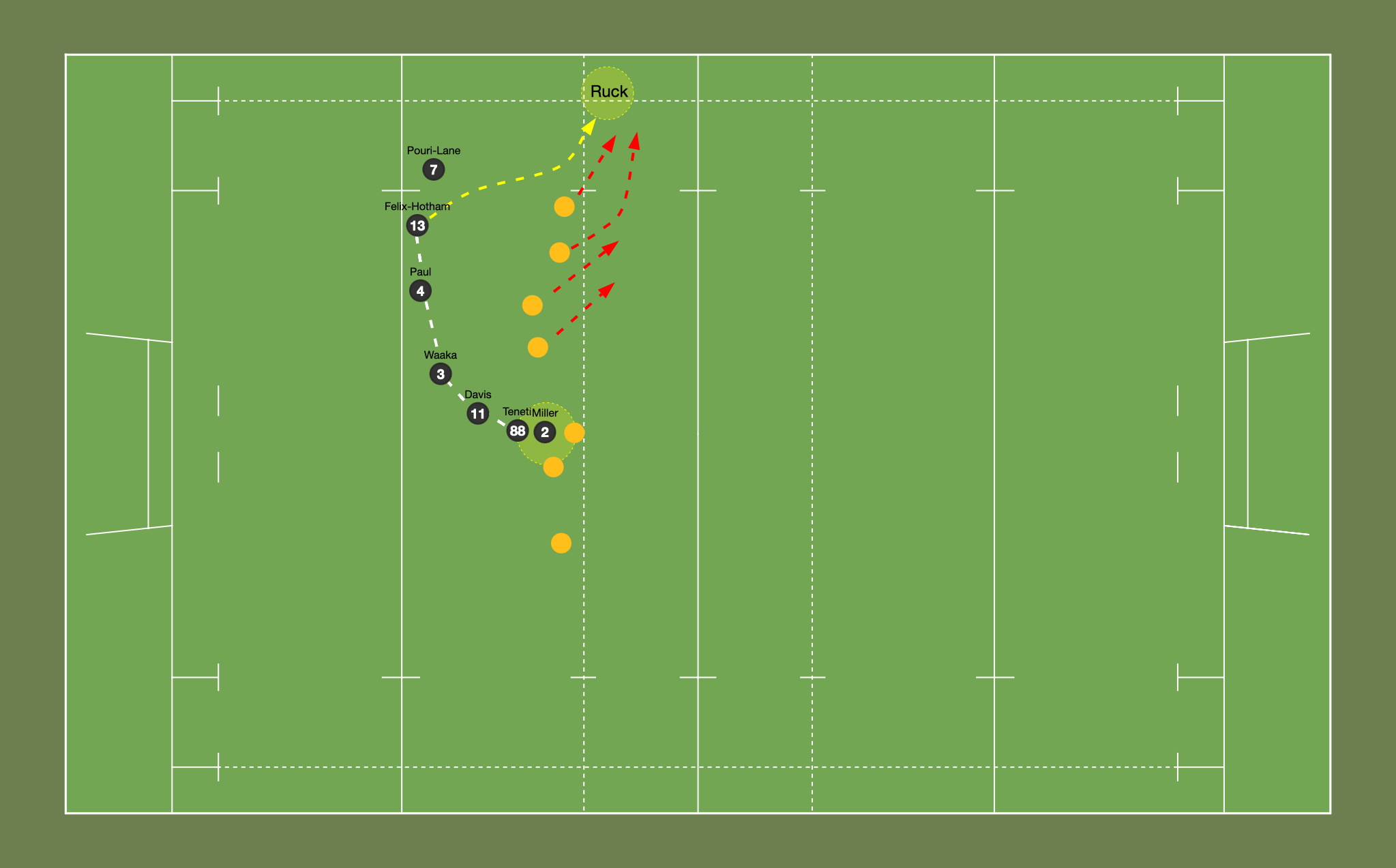
We can see Australia initially transition from losing the ball very well, but are backing off at an angle to protect the edge. Felix-Hotham seeing this takes the space they offer which is infant of her.
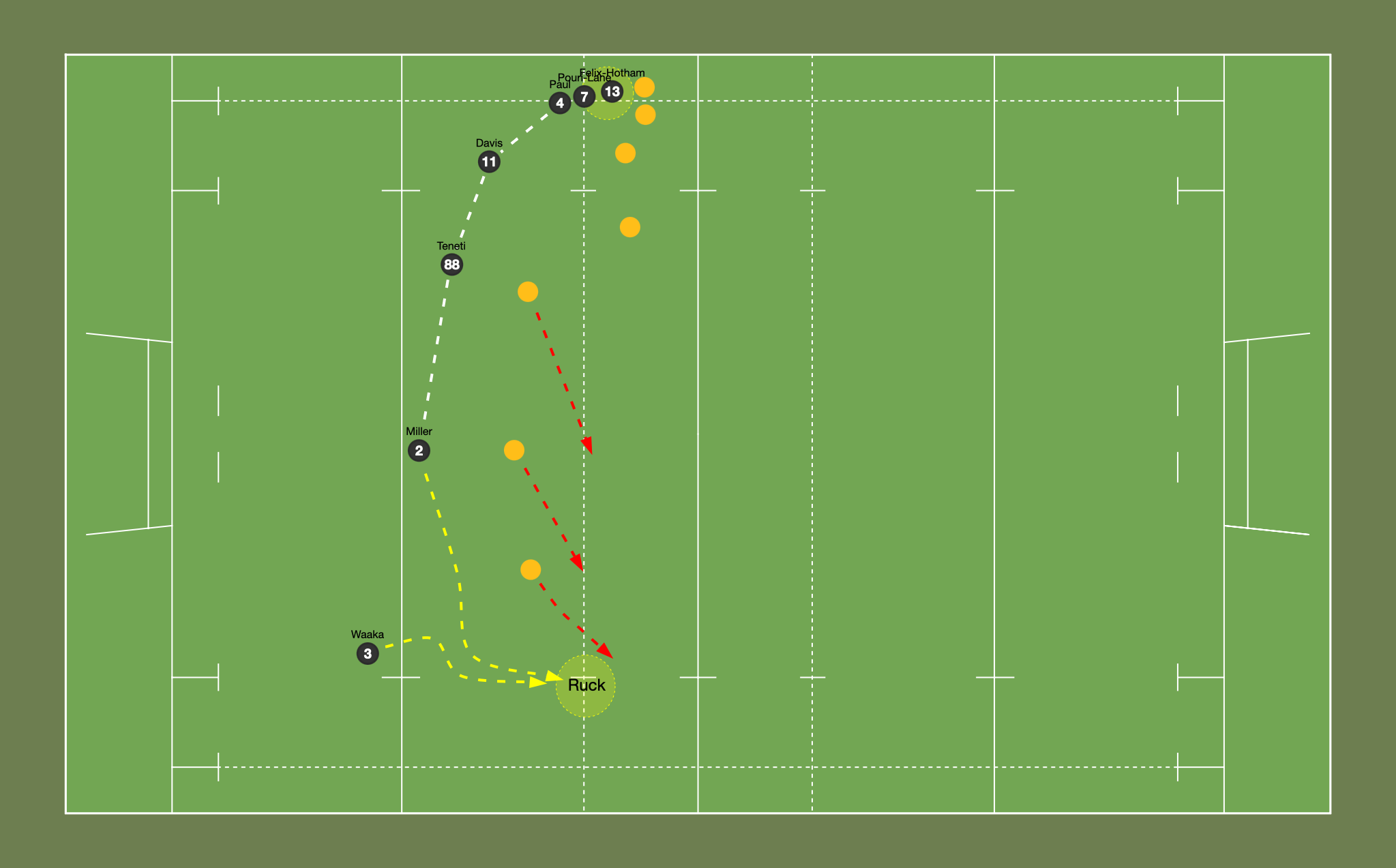
This is a great option, she could have tried to work with Pouri-Lane but this instead puts New Zealand in positive space, sending the Australians backwards.
As we start Phase two, the heavily compressed Australian defence allows New Zealand to exploit the far edge.
Two passes away from the ruck and although Australia are moving forward they are very compressed, Levi on the left wing is around the middle of the pitch and with Waaka wide this allows Miller to forget the inside defence and target Levi, who has to back off, again giving New Zealand space to run into.
Although it doesn’t seem like New Zealand are making much ground they are starting to separate the Australian defence, it’s becoming harder for them to stay connected and we can see they are able to exploit this with their movement over the next phase.
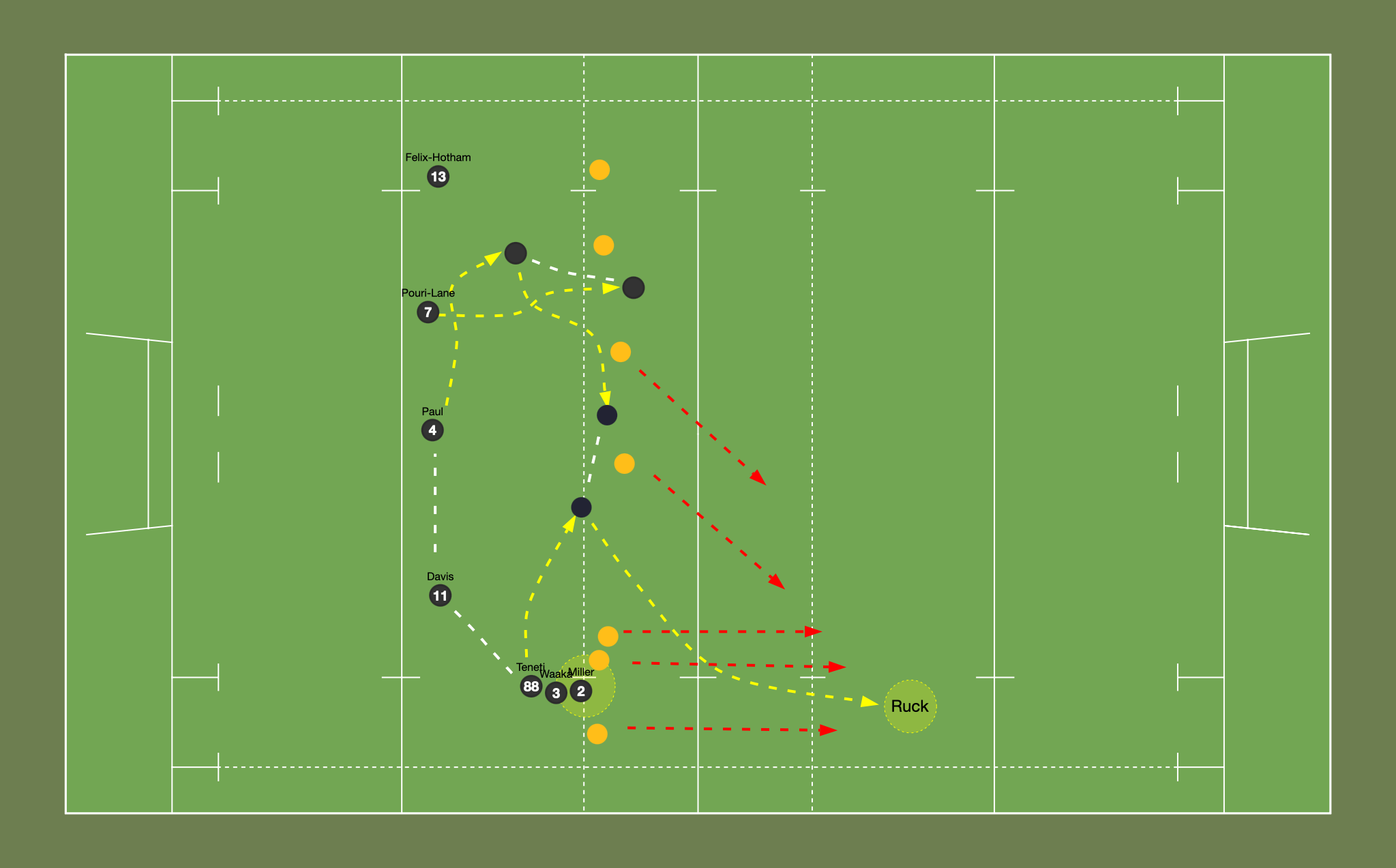
Again, they don’t needlessly place their wing under pressure and instead stop the drift by switching and cutting back.